
Solar Panel Removal & Reinstallation
We take the array off, the roof goes on, we put it back and get it producing. Both crews are ours, so it runs on one schedule.
$250–$300 per panel, typical
Roofing and solar under one roof
We service systems we didn’t install
Central & western Virginia
Your roof needs replacing and there are twenty-two panels sitting on it. The roofer won’t touch them. The company that installed them stopped answering the phone two years ago.
That’s most of the calls we get. Contractors call this a detach and reset. It’s the same job either way, and we handle both halves of it.
What Detach & Reset Costs
| Job type | Cost per panel | 20-panel system |
|---|---|---|
| Standard pitch, good access | $250 – $300 | $5,000 – $6,000 |
| Steep pitch or complex array | up to $350 | up to $7,000 |
| Existing Earth Right customer | Per your contract | Usually lower |
That covers detaching the modules and racking, protecting them, and reinstalling the system as it was.
It does not cover parts we find broken once the array is off. On a system somebody else installed, we find broken parts more often than not. We price those separately and show you before we do anything.
Already an Earth Right solar customer? Your per-panel cost is written into your original contract. Pull it up before you call.
Send us your panel count and roof pitch and we’ll get you a number.
First Question: Do You Own Your Panels?
It’s the first thing we ask, and it decides how the job runs
You own the system
Bought outright or financed with a loan. We work directly with you and schedule around your roof. Straightforward.
You lease the system
The leasing company owns the hardware on your roof, so they have to authorize the work. That doesn’t stop anything, it just adds a phone call before we schedule.
Every major lease company follows roughly the same process: you contact them, explain what’s happening, and they approve and often fund the work on their own equipment.
Leasing has grown fast since the residential tax credit went away. We handle these constantly. Right now we’re running a job where a windstorm dropped a tree onto a leased array: the homeowner’s insurance is covering the roof, the lease company’s insurance is covering the panels, and we’re doing the detach, the roof, and the reset while coordinating both claims.
Does insurance cover a detach and reset?
Only when there’s a covered loss underneath storm, tree, hail. Replacing a worn-out roof at end of life is out of pocket.
If storm damage caused it, the removal usually falls inside the roof claim. If you lease, the panels go through the lease company’s insurance separately from your homeowners policy.
How the Job Runs
01
Site visit
We look at the array, the pitch, and how it’s attached, then quote the job. Not off a phone call.
02
Detach
One or two days before the roof. Modules, rails, and electrical come off. Roof attachments stay in.
03
Roof
Tear-off, deck inspection, and the new roof, on the roofing crew’s schedule.
04
Settle
Three to four days before anyone walks it, so the shingles set and the sealant strips aren’t scuffed.
05
Reset & recommission
Array back on new flashing, rewired, tested, producing again.
About two weeks start to finish when we do both. Using a separate roofing contractor typically adds half a week to a week, because two schedules have to line up and rain delays don’t cooperate.
Your Roof Is Never Left Open
An array isn’t just modules. Attachments are lag-bolted through the decking into rafters, flashed and sealed, with rail mounted on top.
Pull those early and you’ve left forty open penetrations in a roof about to sit through a night of weather. So we don’t. We take off the modules, rails, and wiring, and leave the attachments in the roof.
The roofing crew pulls them last, as they tear off that section, and new flashing goes down behind them the same day. Nothing sits exposed overnight.
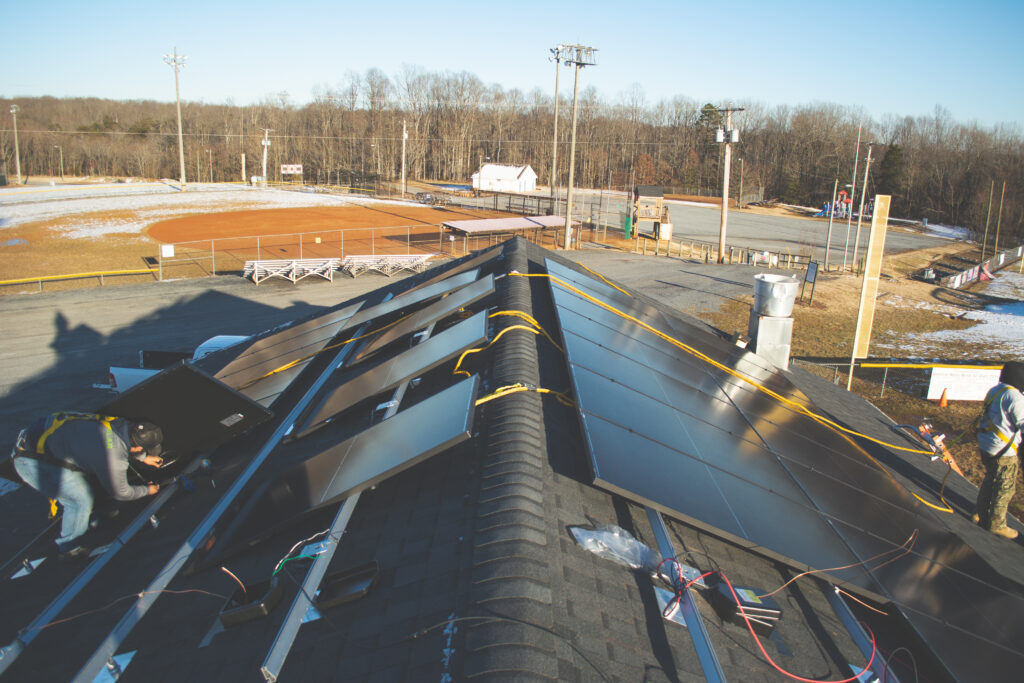
Where your panels go in the meantime
On your property, almost always. Palletized, tarped, and set out of the roofing crew’s way.
If the lot’s too tight or leaving equipment out isn’t practical, we’ll crate them and store them at our warehouse. There’s a transport and storage fee and we’ll tell you what it is before we start.
We Work on Systems We Didn't Install
Most of our detach and reset work is on somebody else’s array. Here’s the honest version of what we can and can’t promise.
- We warranty our workmanship on the reattachment.
- We can’t warranty equipment we didn’t install or spec. A module already failing before we touched it isn’t something we can stand behind.
- Once the array is down we can finally see underneath. Chewed wire, corroded connectors, and degraded string wiring turn up regularly, and animals get under panels and chew roof while they’re at it.
- When we find it, we price it and show you. You decide whether to repair or put it back exactly as found. We’ll reinstall and reconnect without repairing anything if that’s what you want. It just goes back up not producing what it should, and we’ll say so before we do it.
Having anyone but your original installer service the array typically voids that installer’s warranty. For most people who call us, that company no longer exists, so there’s nothing left to void.
If Your Solar Company Went Out of Business
We see a lot of orphaned systems in this region, and there are two things worth knowing before you spend money.
Call the equipment manufacturer first
Manufacturers keep networks of contractors they trust where the original installer is gone. We get dispatched this way regularly, and sometimes the manufacturer covers the failed component and you only pay labor.
Don't hire a general electrician
We’ve been called out to clean up after electricians with no PV experience who made a system worse and, twice, made it unsafe. String voltage on a live array behaves nothing like the branch circuits they work on daily. A licensed electrician is not automatically a solar technician.

Sometimes we tell you not to put it back
If the array is 10 to 15 years old with the big low-wattage modules of that era, the math changes. Paying $250 a panel to reset equipment producing a fraction of what current modules do isn’t a good trade. Same with an aging inverter or first-generation microinverters.
If you’re already paying the labor to get everything off the roof, that’s the cheapest moment you’ll ever have to upgrade, and newer equipment gets you consumption monitoring instead of production-only.
We won’t push you. There are 15-year-old arrays around here still putting out real power. But if you’re about to spend money reinstalling something that should be replaced, we’ll say so.
Taking the system off for good
Different job, and simpler than people expect. No new permit is required. The utility does need to be notified, since their records show a generating system at your address and that number is going to zero, and the county generally wants the update too.
The electrical side is usually minimal. It gets more involved when someone wants every trace gone, including a disconnect spliced between the meter and the main panel — pulling that means redoing service conductors for no real benefit. We almost always recommend leaving a dead disconnect where it sits.
Why Both Halves Should Be One Company
Shorter timelines
Nobody’s waiting on a callback. When the roof moves up two days, the detach moves up two days.
Layout planned in advance
Solar attic fans, conduit runs, and vent placement all have to work around where the array is going back. Our roofer has the layout before the first bundle goes up.
Warranty stays in one place
The same company puts the penetrations back through the new roof, so there’s no argument later about whose work caused a leak.
Already have a roofer you trust? Use them. We’ll still do the solar side. We’ll inspect the roof before we reattach, and if the workmanship isn’t up to standard we won’t warranty the penetrations we put through it. We’ll tell you that before we start, not after.
Service Area
Lynchburg · Forest · Bedford · Moneta & Smith Mountain Lake · Rocky Mount · Roanoke & Roanoke County · Daleville · Cloverdale · Charlottesville & Albemarle County · Staunton · Waynesboro · Fishersville · Stuarts Draft · Blacksburg · Christiansburg
Get Your Detach & Reset Quoted
Tell us your panel count, roof pitch, and who installed the system. If you know whether you own or lease, that speeds things up.
Frequently Asked Questions
Yes. It’s a routine job for a qualified solar contractor and it’s required any time the roof underneath needs replacing. Panels, racking, and electrical come off, the roof work happens, and the system goes back on the new roof and gets recommissioned.
Typically $250 to $300 per panel, up to $350 for steep pitches, hard access, or arrays split across several roof planes. A 20-panel system generally lands between $5,000 and $6,000, before any damaged equipment found once the array is off.
Most don’t. Roofing crews aren’t trained or licensed for live PV work, so they need a solar contractor to pull the array first. Earth Right does both, which is why our projects run on one schedule instead of two.
About two weeks start to finish when one company handles both. The detach is a day or two, the roof runs on its own schedule, and we wait three to four days after the roof is finished before reinstalling. Add half a week to a week with a separate roofing contractor.
Only when there’s a covered loss underneath, like storm or tree damage. An end-of-life roof replacement is out of pocket. If you lease, the leasing company’s insurance typically covers the panel side while your homeowners policy covers the roof.
Nothing gets left open. Modules, rails, and wiring come off but the roof attachments stay in place until the roofing crew tears off that section, so no penetration sits exposed through weather.
On your property in most cases, palletized and tarped out of the crew’s way. If that won’t work we can transport them to our warehouse for an additional fee.
Yes. We warranty our workmanship on the reattachment but can’t warranty equipment we didn’t install. If we find damaged wiring or failed components once the array is down, we price the repair and you decide.